Martes, Oktubre 11, 2011

Huntington’s Disease


HD results from genetically programmed degeneration of nerve cells, called neurons, in certain areas of the brain. This degeneration causes uncontrolled movements, loss of intellectual faculties, and emotional disturbance. Specifically affected are cells of the basal ganglia, structures deep within the brain that have many important functions, including coordinating movement. Within the basal ganglia, HD especially targets neurons of the striatum, particularly those in the caudate nuclei and the pallidum. Also affected is the brain's outer surface, or cortex, which controls thought, perception, and memory.

Involves disturbance in neurotransmitter substance primarily: Gamma Aminobyutric Acid (GABA) & Dopamine 


                     GABA neurons in basal ganglia, frontal                                   cortex and cerebellum are destroyed
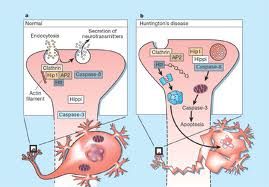
GABA neurotransmitter production 

Excess of dopamine causes abnormal neurotransmission along the affected pathway


Chorea and mental deterioration 

 
Enlargement of the ventricles in HD patients due to atrophy of
the head of the caudate from neuronal loss. 

Amyotropic Lateral sclerosis

Amyotropic Lateral Sclerosis

A rapidly progressive, invariably fatal neurological disease that attacks the nerve cells (neurons) responsible for controlling voluntary muscles. The disease belongs to a group of disorders known as motor neuron diseases, which are characterized by the gradual degeneration and death of motor neurons. Mental status of the patient is intact and not affected.
ALS results from degeneration of: 

  • upper motor neurons in the medulla oblongata
  • lower motor neurons in the spinal cord 
Motor neurons in medulla oblongata and spinal cord die 


Muscle atrophy (loss of muscle tone)


Cephalalgia

HEADACHE

Pain in the head caused by dilation of cerebral arteries or muscle contractions.


 results from pressure on 
pain receptor (prostaglandin)
inflammation occurs
 increase pressure
muscle tension


Increased intracranial pressure

INCREASED INTRACRANIAL PRESSURE

  Intracranial pressure (ICP) is the pressure in the skull that results from the volume of three essential components: cerebrospinal fluid (CSF), intracranial blood volume and central nervous system tissue. The normal intracranial pressure is between 5-15 mmHg.


TRAUMA


EDEMA 

                                            
                                              ICP

  
BLOOD VESSEL COMPRESSION


 OXYGEN PERFUSION IN THE BRAIN


 BRAIN CELL DEATH
 

Myasthenia Gravis

MYASTHENIA GRAVIS (MG)

Chronic autoimmune neuromuscular disorder affecting the neurumuscular joint. It is purely a MOTOR Disorder with no effect on sensation or coordination. 


  •  characterized by fatigue and severe weakness of skeletal muscles.
  • occurs with remissions and exacerbations.
  • occurs more frequently in females, with onset between ages 20-30 
Manifestations:

  • Ptosis (drooping of eyelids), Diplopia (double vision)
  • weakness in mouth muscles resulting in dysarthria and dysplagia
  • weak voice, smile appears as snarl.
  • muscles are weak but DTRs are normal 
Complications:
       Pneumonia
       Myasthenic crisis
  • Sudden exacerbation of motor weakness putting client at risk for respiratory failure and aspiration
  • Manifestation: tachycardia, tachypnea, respiratory distress, dysphasia
      Cholinergic Crisis
  • Occurs with overdosage of medications (anticholinesterase drugs) used to treat MG
  • Develops GI symptoms, severe muscle weakness, vertigo and respiratory distress
Diagnostic Tests:
  • physical examination and history
  • Tensilon Test: edrophonium chloride administered and client with myasthenia will show significant improvement lasting 5mins.
  • EMG: reduced action potential
  • Antiacetylcholine receptor antibody serum levels; increased in 80% MG clients; used to follow course of treatment
  • Serum assay of circulating acetylcholine receptor antibodies
Medications:
  • Anticholinesterase medications [pyridostigmine bromide 'Mestinon']
  • Immunsuppression medications including glucocorticiods (cyclosporineor azathioprine 'Imuran')
Nursing Care:
  • Teaching interventions to deal with fatigue
  • Importance of following medication therapy 
Nursing Diagnosis:
  • Ineffective airway clearance
  • Impaired swallowing: plan to take medication to assist with chewing activity 


Epilepsy

EPILEPSY
Epilepsy is a disorder of the brain's electrical system. Abnormal electrical impulses cause brief changes in movement, behavior, sensation, or awareness. These interruptions, known as seizures, may last from a few seconds to a few minutes. 

      GROUP OF NEURONS LOSE ITS AFFERENT STIMULATION 


                                      BECOME EPILEPTOGENIC IN FOCUS

                      
              THESE NEURONS ARE HYPERSENSITIVE AND EASILY ACTIVATED


FIRE ABNORMALLY


SEIZURE


Lunes, Oktubre 10, 2011

Multiple Sclerosis

MULTIPLE SCLEROSIS

A disease in which the nerves of the central nervous system degenerate. It affects the pathways of the brain and the spinal cord and results in the destruction of myelin, a covering or insulation for nerves, that improves the conduction of impulses along the nerves and also is important for maintaining the health of the nerves.


WHEN MULTIPLE SCLEROSIS ATTACKS

In multiple sclerosis, an agent such as a virus or foreign antigen, in theory, may alter or interact with the immune system so that the immune system perceives myelin as an intruder and attacks it. Inflammation occurs and causes myelin to disappear. Consequently, the electrical impulses that travel along the nerves decelerate, that is, become slower. In addition, the nerves themselves are damaged. While some of the myelin may be repaired after the assault, some of the nerves are stripped of their myelin covering (become demyelinated). Scarring also occurs, and material is deposited into the scars and forms plaques. As more and more nerves are affected, a person experiences a progressive interference with functions that are controlled by the nervous system such as vision, speech, walking, writing, and memory.

WHAT HAPPENS WHEN THERE IS MULTIPLE SCLEROSIS